Fishing might seem simple—rod, bait, and patience. But if you’ve ever stood in front of a wall of fishing hooks at a store, you know it’s more complex than that. Choosing the right hook size is crucial to successful fishing. In this guide, we’ll break down fishing hook sizes with clear charts, explain how to match them to species and bait, and help you understand the different hook types.
Understanding Fishing Hook Sizes
Fishing hooks use a somewhat confusing sizing system that beginners often find overwhelming. There are two sizing scales:
- Standard Size (non-aught): These range from size 32 (smallest) to 1 (largest)
- Aught Size (“/0”): After size 1, the scale reverses and goes 1/0 to 20/0, where 1/0 is the smallest aught, and 20/0 is massive
Why This Matters
Smaller hooks are best for delicate baits and smaller fish like panfish or trout. Larger hooks are used for big-game species like catfish, muskie, or sharks.
Fishing Hook Size Chart (Standard and Aught)
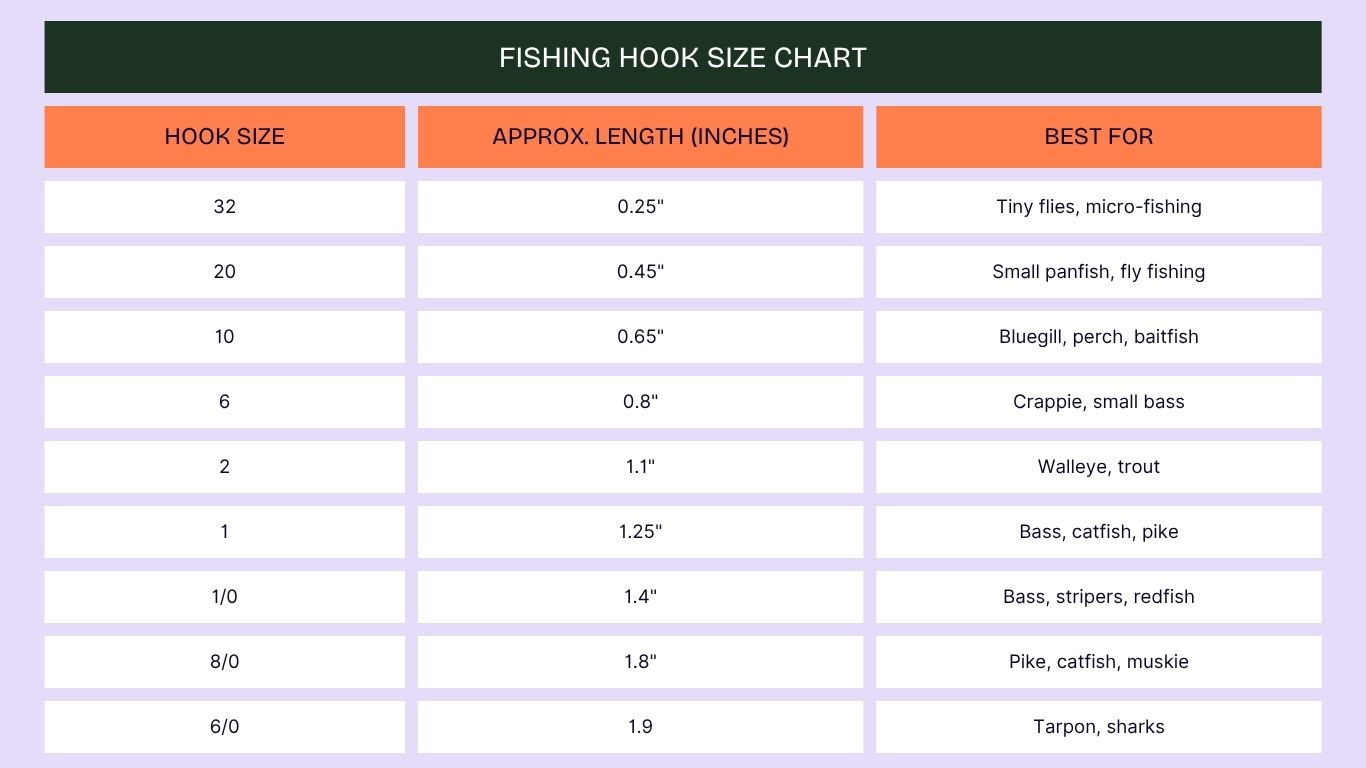
General Fishing Hook Size Chart
| Hook Size | Approx. Length (inches) | Best For |
| 32 | 0.25″ | Tiny flies, micro-fishing |
| 20 | 0.45″ | Small panfish, fly fishing |
| 10 | 0.65″ | Bluegill, perch, baitfish |
| 6 | 0.8″ | Crappie, small bass |
| 2 | 1.1″ | Walleye, trout |
| 1 | 1.25″ | Bass, catfish, pike |
| 1/0 | 1.4″ | Bass, stripers, redfish |
| 4/0 | 1.8″ | Pike, catfish, muskie |
| 8/0 | 2.3″ | Tarpon, sharks |
| 12/0 | 3.1″ | Deep sea species, tuna |
| 20/0 | 4.5″+ | Big game fishing (sharks, etc.) |
How to Read a Hook Size Chart
Understanding the Two Scales
- Smaller Number = Larger Hook (1 to 32)
- Size #1 is larger than size #6
- Size #1 is larger than size #6
- Larger Aught Number = Larger Hook (1/0 to 20/0)
- Size 5/0 is larger than 2/0
- Size 5/0 is larger than 2/0
Common Misunderstandings
- #2 vs 2/0: A size #2 hook is much smaller than a 2/0 hook.
- “/0” (aught) numbers are used mainly for larger, heavier-duty fishing situations.
Matching Hook Size by Fish Species
Freshwater Species
| Fish | Recommended Hook Size |
| Bluegill | #10 to #6 |
| Crappie | #8 to #4 |
| Trout | #12 to #6 |
| Walleye | #6 to #2 |
| Bass | #2 to 3/0 |
| Catfish | 1/0 to 5/0 |
| Pike/Muskie | 2/0 to 8/0 |
Saltwater Species
| Fish | Recommended Hook Size |
| Redfish | 2/0 to 5/0 |
| Snook | 3/0 to 6/0 |
| Tarpon | 5/0 to 10/0 |
| Tuna | 6/0 to 12/0 |
| Shark | 10/0 to 20/0 |
Choosing Hook Size by Bait Type
Live Bait
| Bait | Recommended Hook Size |
| Worm | #8 to #2 |
| Minnow | #6 to 1/0 |
| Shrimp | #2 to 2/0 |
| Leech | #6 to #1 |
Artificial Baits
| Bait Type | Hook Type | Size Range |
| Soft Plastics | Offset/Jig | #2 to 5/0 |
| Crankbaits | Treble | #6 to 1/0 |
| Spinnerbaits | Single | 1/0 to 5/0 |
| Topwater Frogs | Double | 4/0 to 6/0 |
Hook Size and Hook Types: J-Hook, Circle Hook, Treble
J-Hooks
- Commonly used for all-around fishing
- Require active hook set
- Available in wide range of sizes (from #12 to 10/0)
Circle Hooks
- Designed for catch-and-release
- Set themselves in the corner of the fish’s mouth
- Often sized slightly larger than J-hooks for same fish
Treble Hooks
- Triple-pronged, great for lures
- Each size has three hooks, reducing missed strikes
- Sizing same as J-hooks but often shorter shank
Factors That Affect Hook Size Selection
Fish Size and Species
- Larger fish = larger hooks
- Fish with bony mouths (bass, catfish) require strong, sharp hooks
Fishing Technique
- Casting lures: Use smaller hooks for better action
- Bottom fishing: Bigger hooks with heavier gauge wire
Water Clarity and Depth
- Clear water: use smaller, less visible hooks
- Murky water: larger hooks acceptable
Type of Hook Set
- Fast and aggressive? J-hook
- Passive or slow? Circle hook
Printable Fishing Hook Size Chart (PDF Idea)
Consider adding a downloadable PDF with:
- Standard & Aught Chart
- Species and Bait Matching Table
- Hook Type Visuals
Final Thoughts
Picking the right hook size can dramatically increase your chances of catching fish. A hook too large can spook fish or prevent proper hook-ups, while a hook too small may not hold up. Match the hook size to your bait, species, and technique.
FAQs
What is the largest hook size available?
The largest commonly available fishing hook size is 20/0 (pronounced “twenty aught”). This size is massive and primarily used for deep sea fishing, especially when targeting very large species such as giant tuna, sharks, marlin, or swordfish. These hooks are thick, strong, and built to withstand the extreme pulling power of ocean predators. While 20/0 is the upper commercial limit, some custom hook manufacturers may offer even larger sizes for specialized big-game anglers.
What does 2/0 mean in hooks?
The “2/0” hook size, spoken as “two aught,” refers to a hook that is larger than size #1. The aught scale begins where the standard sizing ends, and each increase in aught (1/0, 2/0, 3/0, etc.) means a larger hook. The 2/0 hook is a versatile mid-sized hook suitable for many freshwater and saltwater species like bass, catfish, redfish, and striped bass. It’s ideal when you need a hook big enough to hold larger bait without being so large that it deters strikes.
Is there a universal hook size for beginners?
While there is no one-size-fits-all hook, beginners often do well with hook sizes in the #4 to 1/0 range. These sizes are:
- Small enough for most panfish, bass, and trout
- Big enough to hold various baits like worms, leeches, or soft plastics
- Not too intimidating for newcomers to rig or cast
A #6 or #4 hook works well for small fish like bluegill or perch. A 1/0 hook is better for bass or catfish. Beginners should start with a small selection across this range and adjust based on local fishing conditions.
Are treble hooks smaller than single hooks?
Yes, treble hooks often appear smaller than single hooks of the same size number. This is because:
- They consist of three prongs joined by a single shaft.
- The shank is usually shorter, and the gap between points is tighter compared to single hooks.
- Manufacturers often scale treble hooks based on shaft length, not the gap or overall size.
A size #6 treble hook is significantly smaller than a size #6 single hook. When switching from a single to a treble on a lure, anglers often go a few sizes smaller in number to maintain balance and avoid affecting the lure’s action.
How do I know if my hook is too small or too big?
Too Small:
- Fish may steal your bait without getting hooked.
- You might feel bites but fail to hook the fish consistently.
- Smaller hooks can bend or break when fighting larger fish.
- They may not penetrate tough mouths, especially in species like bass or redfish.
Too Big:
- Fish may ignore the bait entirely if the hook is overly visible or too heavy.
- It can impede natural bait movement, making live or soft baits less attractive.
- Oversized hooks reduce hook-up rates on small-mouthed fish.
- They can tear through the bait, causing it to fall off or sit awkwardly in the water.